Concreteness norms
Human ratings from 1 (abstract) to 5 (concrete) for 5,814 verb-object expressions, the first human-rated Slovene word norms, and model predictions for a much larger set.
Download concreteness normsHuman concreteness ratings and figurative or literal judgements for verb-object expressions in English, German and Slovene, such as throw ball and carry implication, with 9,000 example sentences written by native speakers.
Human ratings from 1 (abstract) to 5 (concrete) for 5,814 verb-object expressions, the first human-rated Slovene word norms, and model predictions for a much larger set.
Download concreteness normsFigurative or literal labels for 1,800 verb-object expressions, with 9,000 example sentences written by native speakers.
Download figurative judgementsEach archive holds tab-separated UTF-8 files and a README describing every column.
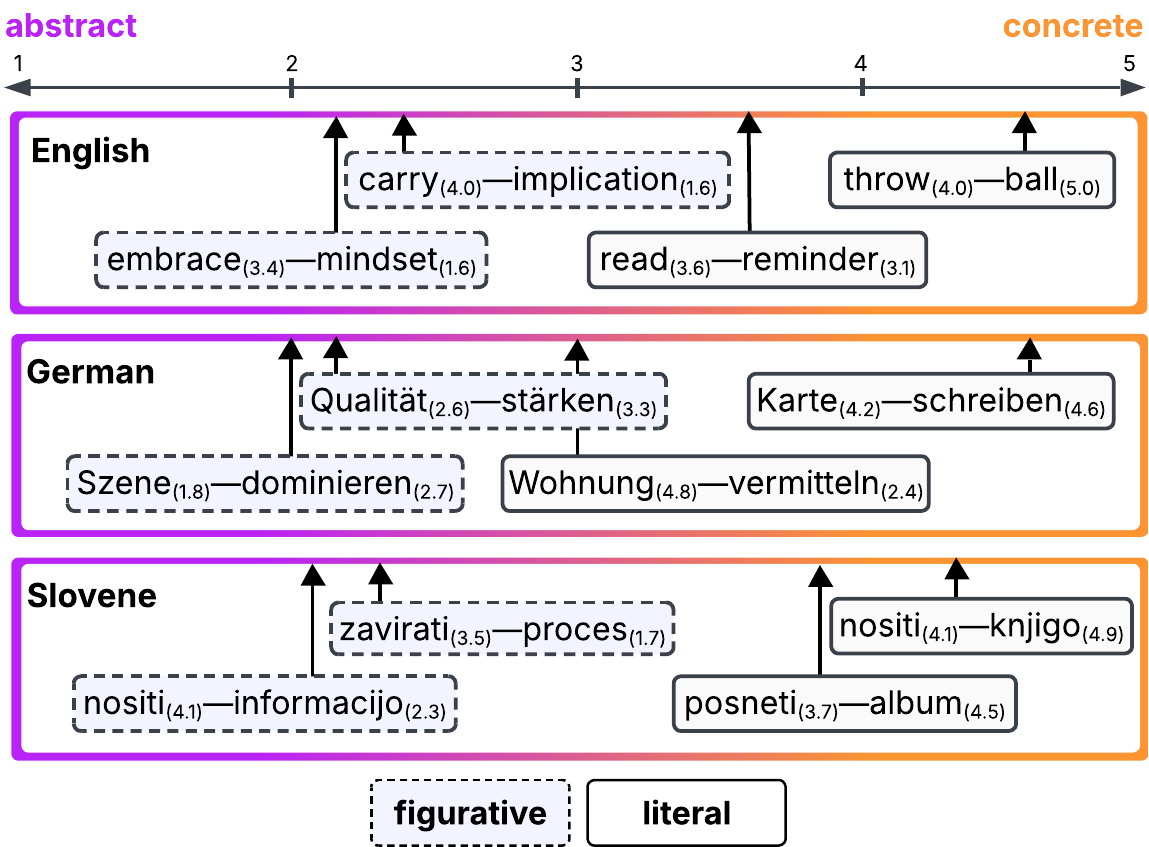
| File | Rows | Contents |
|---|---|---|
vo_expressions/english.tsv |
1,998 | Human ratings for verb-object expressions, 5,814 in total |
vo_expressions/german.tsv |
1,818 | |
vo_expressions/slovene.tsv |
1,998 | |
vo_expressions/english_rating_scale.tsv |
1,823 | The same English expressions rated a second time on a 1 to 5 scale, for comparing the two methods |
words/slovene.tsv |
798 | First of its kind for Slovene Human-rated Slovene word concreteness norms for 600 nouns and 198 verbs |
vo_generated/english.tsv |
470,856 | Model-predicted ratings for every other expression extracted from the corpora, 613,602 in total |
vo_generated/german.tsv |
56,406 | |
vo_generated/slovene.tsv |
86,340 |
For 600 expressions per language, five native speakers each judged the expression figurative or literal and wrote a sentence using it. Together this makes a multilingual resource for figurative language and metaphor research.
| File | Rows | One row per |
|---|---|---|
judgements.tsv |
1,800 | Expression, with the majority decision and its concreteness score |
example_sentences.tsv |
9,000 | Sentence, with the decision made by the person who wrote it |
Labels need four of five annotators to agree; a 3 to 2 split is unsure.
| Expression | Label | Concreteness | Example sentence |
|---|---|---|---|
| carry uncertainty | figurative | 2.20 | She carried uncertainty when faced with a difficult problem. |
| buy oil | literal | 4.35 | I went to the supermarket to buy some oil |
Transactions of the Association for Computational Linguistics, volume 14, pages 1205–1224, 2026.
Concreteness norms usually rate single words. We rated verb-object expressions instead, 5,814 of them across three languages, extended them to a much larger set with automatic methods, and had a subset judged figurative or literal.

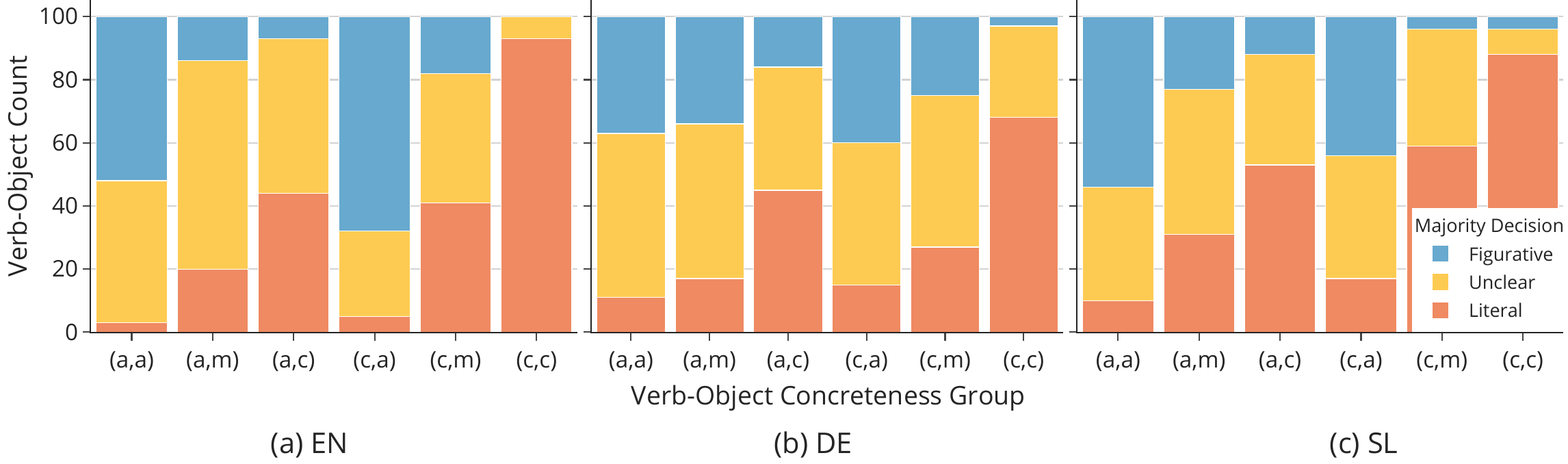
unsure labels, shown as Unclear.

english_rating_scale.tsv.
We compared a baseline, fine-tuned monolingual models and prompted LLMs (monolingual and multilingual, zero- and few-shot). The fine-tuned models did best and produced the released ratings. The full comparison is in the paper.
| Language | Model | Spearman ρ | RMSE | Baseline ρ |
|---|---|---|---|---|
| English | RoBERTa | .88 | 0.38 | .75 |
| German | GBERT | .87 | 0.45 | .77 |
| Slovene | SloBERTa | .82 | 0.54 | .49 |
Urban Knupleš, Diego Frassinelli, Alexander Fraser, and Sabine Schulte im Walde. 2026. Literally Concrete or Figuratively Abstract? Multilingual Concreteness Norms for Verb-Object Expressions. Transactions of the Association for Computational Linguistics, 14:1205–1224.
@article{knuples-etal-2026-concreteness,
    title     = {Literally Concrete or Figuratively Abstract? {M}ultilingual
                 Concreteness Norms for Verb-Object Expressions},
    author    = {Knuple{\v{s}}, Urban and Frassinelli, Diego and
                 Fraser, Alexander and {Schulte im Walde}, Sabine},
    journal   = {Transactions of the Association for Computational Linguistics},
    volume    = {14},
    pages     = {1205--1224},
    year      = {2026},
    doi       = {10.1162/tacl.a.703}
}